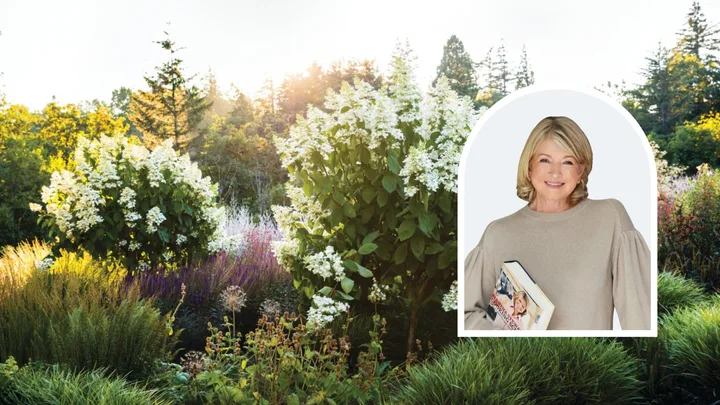
 Photography: (garden) Claire Takacs / (portrait) Victor Demarchelier / Copyright: Martha Stewart Living Omnimedia LP
White gardens are a century-old trend popularised by renowned British writer and gardener Vita Sackville-West at Sissinghurst Castle, in the UK. These monochromatic displays look especially stunning at night, when the white blossoms glow in the twilight.
All-white gardens are hardly monotonous. Just as every ray of white light contains a rainbow, ‘white’ flowers present a vast spectrum of pale tones. Then there’s the foliage, which also comes in various hues. In fact, Sackville-West, who strolled through her white plot before and after dinner, actually described it as “my grey, green, and white garden”.
That statement sums up the ingredients of any successful white-themed display – silvery grey leaves, deep green foliage, and shimmery white blossoms. Here’s how to adopt a white-themed garden into your landscape so it shines morning, noon and night.

“Equally entrancing is the sweet fragrance that many white blooms exude at night.”
Martha Stewart

Choose the location for your white garden
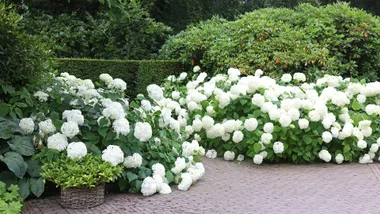
Minimalists may opt to devote their entire landscape to a white palette, while others prefer to embrace a white garden as a standout section of a multifaceted landscape, placing it in a strategic spot for maximum enjoyment – such as where it is visible in the glow of moonlight, whether viewed through a window or from a dining patio. The High Meadow Farm garden (shown below), for instance, holds a prominent spot along an expansive stone terrace overlooking the rolling hills.


Plot your white garden design
As with any garden, you’ll want to create visual interest with a variety of plants, including non-flowering specimens – such as the grasses at High Meadow Farm, which soften edges, capture light, and form diaphanous ‘hedges’ in a curved, sweeping pattern. Boxwoods – including white buddleia, a cloud-pruned boxwood – and other evergreen shrubs are other options. Varying the height is equally essential: consider ground covers around the edges, rising to Echinacea ‘White Swan’, cleome, white cosmos, Verbena bonariensis, and five-foot-tall boltonia, with flowering shrubs like rose of Sharon and climbers such as clematis or roses lending further structure.

Picking plants for an elegant white garden
You may be surprised at just how many species fit into a white garden. As with any palette, consider foliage as well as blossoms. Follow Vita’s example and create interest with different shapes, textures and form.
1. Think beyond true white
Taking inspiration from the white-blooming plants at Sissinghurst and other well-known gardens, expand beyond ‘white’ to include bulbs, annuals, perennials, shrubs and flowering trees in a range of shades. What’s more, white blossoms reflect and highlight adjacent hues – and contain touches of other shades, such as blush pink or buttery yellow – and take on a golden glow as they age. Consider, too, plants with variegated foliage for glimpses of white or pale green.
2. Extend the season
Choose plants with different bloom times, referring to the glossaries below for plants that blossom in early spring, late summer and in between – some featured in the garden at High Meadow Farm (shown above), north of New York City. Although lovely year-round, this garden reaches its apex in late summer, just when most other gardens are beginning their decline. That’s when the billowy grasses have reached full size and the dwarf fountain grass is in bloom, joined by peegee hydrangea, buddleia, white echinacea, variegated sedum, gaura and the low-growing rose ‘Carpet White’.
White flowers by season
For a white garden that’s beautiful year-round, include a mix of plants that flower at different times – like these ones.
Early-spring bloomers

- Cornus florida (flowering dogwood)
- Helleborus ‘Brandywine’ (lenten rose)
- Epimedium x youngianum ‘Niveum’ (barrenwort, bishop’s hat)
- Leucojum aestivum (snowflake)
- Narcissus ‘Actaea’ (poeticus daffodil)
- Dicentra spectabilis ‘Alba’ (white bleeding heart)
- Fothergilla gardenii (fothergilla)
Mid- to late-spring bloomers

- Syringa vulgaris ‘Jan van Tol’ (common lilac)
- Pulmonaria ‘Sissinghurst White’ (lungwort)
- Allium ‘Mount Everest’ (ornamental onion)
- Tulipa ‘Purissima’ syn. ‘White Emperor’ (tulip)
- Aquilegia flabellata ‘Alba’ (fan columbine)
- Iris germanica ‘Alba’ (dwarf bearded iris)
- Pieris japonica (Japanese pieris)
- Rhododendron ‘Cunningham’s White’ (white rhododendron)
Summer bloomers

- Boltonia asteroides (false aster)
- Dahlia ‘White Alva’s’ (dahlia)
- Cosmos bipinnatus ‘Sonata White’ (Mexican aster)
- Lysimachia clethroides (gooseneck loosestrife)
- Phlox paniculata ‘Mother of Pearl’ (garden phlox)
- Echinacea purpurea ‘White Swan’ (white swan coneflower)
- Nepeta cataria ‘Snowflake’ (white catnip)
Late-summer bloomers

- Thunbergia alata ‘Bright Eyes’ (black-eyed Susan vine)
- Lilium ‘Casa Blanca’ (oriental lily)
- Platycodon grandiflorus ‘Hakone White’ (balloon flower)
- Hibiscus syriacus ‘Diana’ (rose of Sharon)
- Hosta ‘Ginko Craig’ (hosta)
- Rosa rugosa ‘Alba’ (white rugosa rose)
- Hydrangea paniculata (panicle hydrangea)

This is an edited extract of Martha Stewart’s Gardening Handbook by Martha Stewart, published by Harper Collins, $79.99.